








What Nobody Warned Me About (and What I'm Grateful For)
Written by Lisa Wallace, Marketing Manager at LayUp Technologies.
When people ask what it’s like working at LayUp Technologies, I tend to pause before answering. Not because the answer is complicated, but because it doesn’t look like what most people imagine when they think “fintech company.”
There’s no glass office tower. No fancy boardroom with a long oak table. No early morning traffic-jam ritual where we all crawl toward the same building with coffee cups and slightly frayed patience in hand.
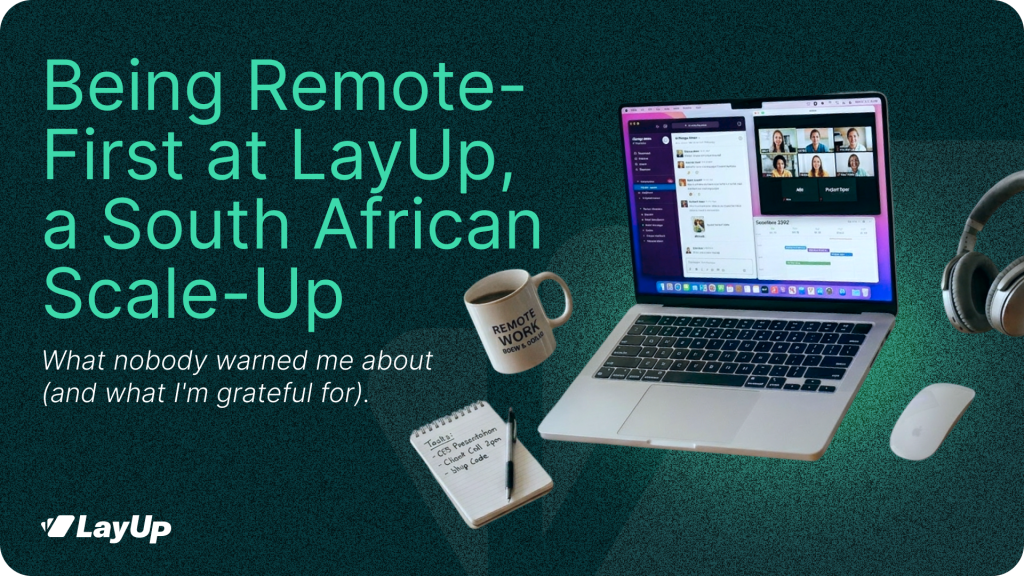
We’re remote-first. And not the polite, optional kind – remote-first by design, by philosophy, and by practice. Our Slack channels are our corridors, our Google Docs are our conference rooms. Our team spans cities and time zones, home offices and the occasional wine farm with a decent WiFi signal and gorgeous views (sans wine because we’re working, right?). And honestly? It has reshaped how I think about work entirely.
ALSO READ: How LayUp Used AI to Relaunch Its Website – And What We Learnt Along the Way
The Financial Case (Which Doesn’t Get Enough Credit)
Let’s start here because, in South Africa, this matters more than LinkedIn thought pieces tend to acknowledge.
LayUp comes unadorned with an office lease; no parking contracts, no daily petrol spend quietly bleeding into a salary that has to stretch further than it used to. At a company built on the principle that financial control beats financial pressure – that transparency and planning are more powerful than credit – our operations are structured to reflect our beliefs. We operate lean, and on purpose. And it works.
What It Does to How You Work
There’s a myth that remote work erodes accountability. In my experience, it eliminates the performance of accountability, which is a different thing entirely.
When you can’t lean across a desk and give a status update, you have to actually document things. Communicate with precision, and think before you send. The intentionality that remote work demands has made our team sharper; deliverables are measured by output, not by visibility alone.
You either move the needle, or you don’t – and there’s a clarity to that which I’ve come to value.
What It Has Done for My Mental Health
This is the part I didn’t expect to write about – and the part I think deserves more honesty. I used to underestimate how much daily friction accumulated before the workday even began. The traffic. The calculating whether to leave 12 minutes earlier because it looked like rain. The low-grade tension of starting your morning already slightly behind, already slightly reactive.
Removing that has changed something in me that I didn’t know needed changing.
I wake up, make coffee in my own kitchen, and ease into the day at a pace that is, for the first time in my working life, actually mine. Some mornings it’s my desk at home. Some mornings it’s a quiet coffee shop with good light and excellent pastries. Occasionally, it’s somewhere with a vineyard view that reminds me why I live in Cape Town at all.
That autonomy has softened something in my nervous system. I’m less reactive, more present, and more capable of the kind of deep, focused work that marketing requires – the thinking before the doing. I get sick less. The low hum of chronic stress that I mistook for just “how work feels” has quieted considerably.
Remote work doesn’t remove pressure. Scale-ups still scale, deadlines still exist, and some weeks are more relentless than others. But it gives you the space to manage pressure from a baseline of calm rather than a baseline of cortisol. That difference has been massively impactful over time.
For a company that champions financial wellness and the idea that control beats credit – that people deserve calm, not just convenience – it feels right that the way we work reflects the same values.
The Honest Trade-Offs
It would be disingenuous to present this as uncomplicated. There are days when you miss the energy of a room, the spontaneous conversation that sparks something new. The ease of turning your chair and resolving something in thirty seconds that takes three Slack messages and a voice note to approximate.
Culture, when you’re remote-first, has to be built with intention. It doesn’t happen by proximity. You have to create the moments that would otherwise emerge organically – and that takes consistent effort, from everyone. In my team, at least.
But for me, the trade-off has been worth it. (And worth it not just professionally, but personally.)
ALSO READ: BNPL or Debt-Free? Choosing the Smarter Path — A Personal Reflection
What This Means for LayUp
LayUp exists because we believe financial services should give people control, not create pressure. That the best outcomes come from planning and transparency, not from impulsive spending driven by clever credit architecture.
Being remote-first isn’t a badge we wear because it sounds progressive. It’s an expression of the same thinking. We’ve built a company that operates without unnecessary weight – leaner, more agile, more human.
And sometimes the best ideas really don’t come from boardrooms. They come from somewhere quieter – a sunlit desk in your favourite home nook, a coffee shop corner accompanied by a very strong brew, a morning that started without travel stress – to which I have a putrid aversion. Where people feel settled enough to think out of the box.
In my experience, that’s where the best work tends to begin.